
Friday, June 5, 2009

where poppies grow


Early every summer our neighbours have a splendid display of poppies along their fence line.
Stunning in the slanted rays
 of morning and evening.
  Blooms turning
 towards the light of the sun.


Thursday, June 4, 2009

the amazing honey bee


"Wall", said Don Hall, a sometimes neighbour, "thar used to be a lot of honey bees in this here chestnut tree.  It would be buzzing in the summer.  But thar gone, everywhere, not just in these parts, thar gone.  And that's a bad thing, cause they pollinate most everything. "


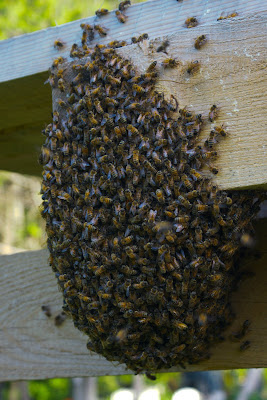
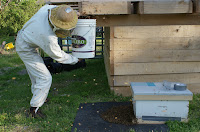
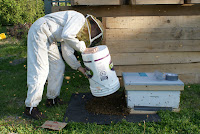
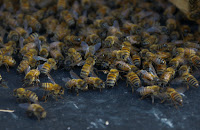
Surprisingly enough, a few hours later, our orchard was swarming with honey bees.  An enormous swarm was dangling between the branches of an apple tree.  Later they moved to a pile of lumber, boxes for our vegetable garden.  Neighbour Susan gave us the phone number of a bee keeper.  And so, began a practical lesson on the amazing honey bee.  It was a terrific experience.  We watched the bee keeper put out a hive.  The excited bees started gesturing with their wings and pointing their backsides to tell their hivemates about the new home.

Bee Keeper John, a wonderful source of information,  estimated that the swarm consisted of  20,000  bees.  Most of these being worker bees, a smaller number of drones and a queen. The worker bees are females  that are looking to start a new hive.  They are the nannies of the bee hive looking after the eggs and feeding the babies.  They select 8 - 20 of the children to become queens and feed them the Royal Jelly which transforms these bees from workers to queens.  The rest  become workers.

Bees tend to swarm at this time of the year, having feasted on apple blossoms and other spring flowers, and awaiting the late June clover.

After the eggs are hatched the workers spend the first 3 weeks of their short lives bustling about the hive feeding new babies.  After that they guard the hive from intruders, and then take to the outside world to become foragers.  While the nannies are busy the queen is also busy laying eggs, up to 2000 in a day.

The drones (the males) of which a swarm may have 2,000, are free to roam about and visit other hives.  However these hapless fellows are evicted from the hives in the fall.  The gentlemen are slightly larger than the ladies but are unable to sting.

As neighbour Hall put it, "bees are in danger".  Beekeeper John tells us that one of the most significant issues facing these ladies is PMS, parasitic mite syndrome.  Specifically the varroa mites.  Miniscule little red creatures that look like crabs, who lay their eggs in the royal jelly and play havoc with the offspring of queen bee.  Some bees are born with damaged wings, and a drone that we saw was missing a leg.  Another enormous problem for the bee population is CCD, colony collapse disorder.  Entire hives can simply die off. Bee keeper John thought this was the result of pesticides and other pollutants.


In the words of Don Hall "we need them honey bees".
Bee keeper John suggests that 40 - 60 percent of our fruit and vegetables are dependent on bees.
Einstein surmised that if the honey bees disappeared within 3 years mankind would too.
Scripture tells us that  "God saw all that he had made,and it was very good."  Each relationship designed by Him.


Our children are blessed with 3 sets of loving grandparents.

3 generations sharing genes, habits and a heritage of faith.

Wednesday, June 3, 2009

walking with a friend

Friends
with whom we can walk and talk,
upbuilding one another
and growing in faith,
mutually blessed .


Tuesday, June 2, 2009

in the garden


The neighbours shared  discarded tulips with us,
 blooms  cut off
to bring surprise colours to our garden 
next spring

The children watched
explored
and helped.

I planted
 in anticipation
 of beauty in the garden
and wonder in fertile minds. 


Monday, June 1, 2009

Love's Miracle


Upon the marsh mud, dank and foul,
A golden sunbeam softly fell,
And from the noisome depths arose
A lily Miracle.

Upon a dark bemired life
A gleam of human love was flung,
And lo, from that ungenial soil
A noble life upsprung.

L.M. Montgomery

pentecost


Dr. G . Visscher preached in our church yesterday, in his usual arresting manner.  My little ones were covering their ears as he raised his voice, and I ....I was convicted... and reassured.
He spoke about Pentecost, when the Holy Spirit came as tongues of fire to rest on the heads of the apostles.  He spoke of the early church.  He spoke of how the signs of a true church were apparent.  These signs can be applied to us as individual christians, families, and churches.  It is good to reflect on this and to realize how horribly we fall short.

1.  A Love for Learning:  
devotion to learning.  Passionate people wanting desperately to know who the Christ was.  What did His death mean? What did His ressurection mean? The ascension? Pentecost? What was the impact?
Me?   Guilty...

2. A Fervor for Fellowship:  
3000 people connected by the Spirit, a sharing of God the Father, the Son as Saviour, and the Spirit.  The Holy Spirit uniting all regardless of age, sex, talent, riches. Not a collection of friends, colleagues, similar people.  Koinonia, sharing, generously, having each other's best interest at heart.   Mutual admiration and love of Jesus Christ.
Caring within our families, our community, nationally and globally.
Me?  Guilty...

3.  Willingness to Worship
Feeling privelidged, "everyone filled with awe".  Profound Joy in the thought that the Son of God came for me and you!  The breaking of bread, each empty  hand raised and filled.  Praying together.  The chief exercise of faith.
Me? Guilty ....

4.  Eagerness for Evangelism: 
"There was added to their number daily".  Full hearts overflowing.  Sharing that which the heart is full of.
Me? Guilty .....

On all four counts? 
Guilty,
but not condemned. 
Redeemed

Thank you Lord, for faithful preachers
for faithful churches!